

How to Create a Cosy Autumn Table: Seasonal Styling for Your Home
There is a week every September when it stops being summer without anyone announcing it. The light goes earlier, the kitchen becomes the warmest room in the house again, and the table stops being somewhere to put things down and becomes somewhere to sit.
Styling a table for autumn does not mean buying a new one, and it does not mean the sort of tablescape that takes an hour to build and cannot be eaten at. It means warmer tones, something lit, a bit of texture, and knowing the order to put things down in. This guide covers all four, in the order we would actually do them.
Start with what you already have
Before buying anything, take everything off the table and put back only the things you use. Most tables are carrying a few items that arrived once and never left. A table feels considered when there is space around what is on it, and that is free.
Then look at what is in the cupboard rather than what is in the shops. Autumn styling is mostly a matter of swapping cool tones for warm ones, and most kitchens already own both. Cream plates instead of white. The wooden board rather than the glass one. A linen napkin instead of paper.
If you are missing one thing, make it the thing that goes in the middle. A table with a good centre reads as intentional even when everything else is ordinary.
The order to lay an autumn table in

This is the part almost no one writes down, and it is the reason some tables look composed and others look piled up. Work outwards from the surface and upwards from the plate.
- The surface. Cloth, runner, or bare wood. Bare is a legitimate choice in autumn, especially on a warm-toned table, and it saves the washing.
- The anchor. A board, a tray or a runner down the centre. Everything else will gather around this, so put it down before anything else.
- The plates. Dinner plate first, then side plate on top or to the left. Leave a hand’s width between each setting so nobody eats with their elbows in.
- The cutlery. Outside in, in the order it will be used.
- The glass. Above the knife, slightly right. This is the one people move by instinct and then wonder why the table looks crowded.
- The napkin. On the plate or under the fork. Folded once, not sculpted.
- The light. Candles last, once you can see where the gaps are.
- The green. Foliage last of all, filling whatever is left rather than dictating the layout.
Doing it in this order takes about four minutes and removes almost all of the fiddling. The common mistake is starting with the decoration, which leaves you rearranging it around the plates afterwards.
Three tones that do most of the work
Autumn palettes go wrong when they reach for orange. What actually reads as autumn is depth rather than brightness, and three tones are enough.
A warm neutral, for the base
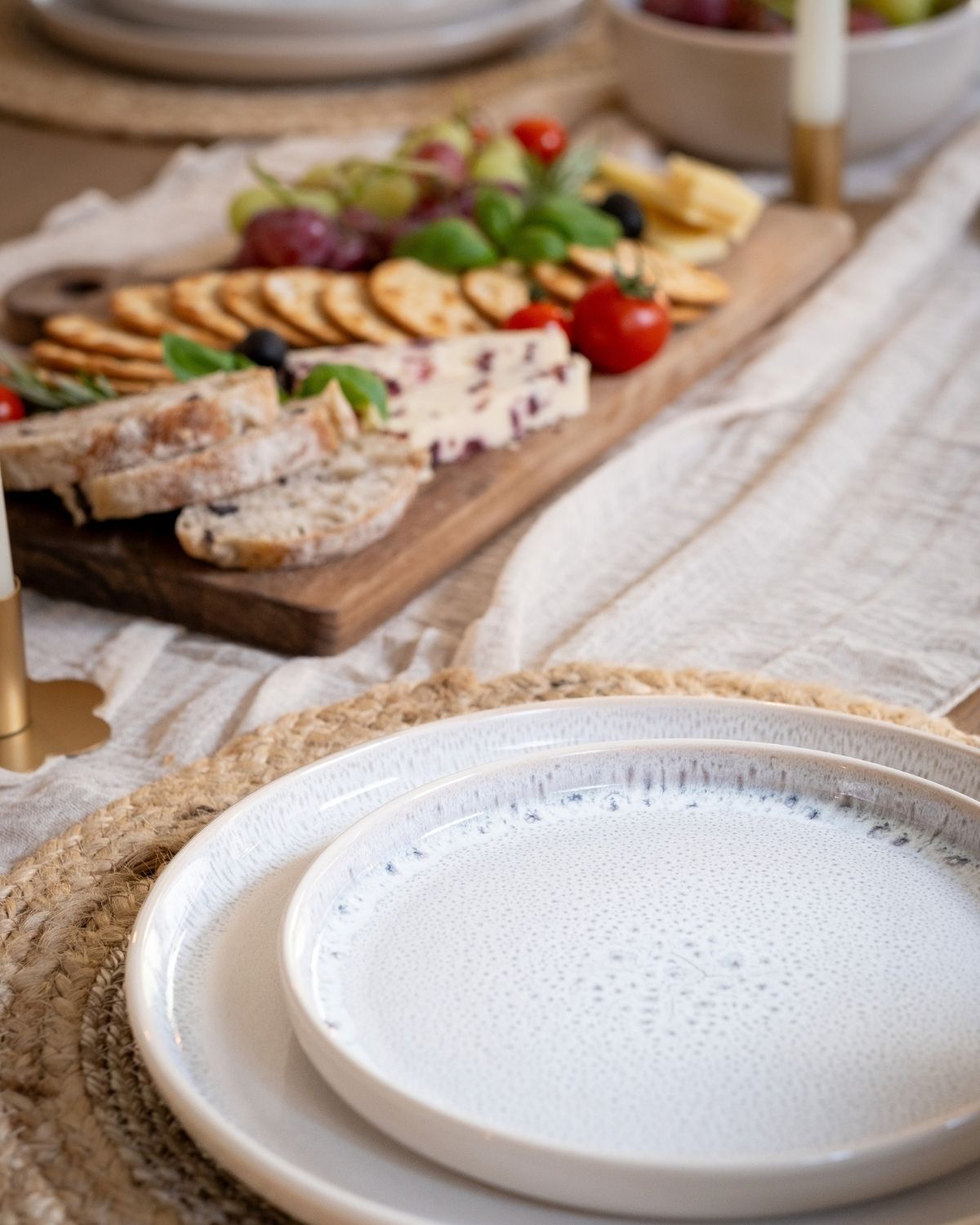
Oatmeal, cream, sand or bare wood. This is the largest area of the table, so it should be the quietest thing on it. Our tableware sets in oatmeal reactive glaze sit in exactly this register, and they carry a table without competing with the food.
A deep colour, for the plates
Blue, green or a soft grey. Deep colours look better under lamplight than pale ones do, which is the whole reason they suit the darker half of the year. The Havn twelve piece set in blue reactive glaze at £80 does a table for four in one box, and the Rivah sixteen piece set in green at £100 does the same in a softer, more olive direction. The Stockholm range in oatmeal reactive glaze, pictured here too, is back in stock in October and suits a warm, neutral table.
One accent, used sparingly
Blush, mustard or rust, and only in one or two places. A pair of reactive glaze mugs at the end of the table is enough. Accent colours work by being outnumbered.
Light is what actually changes the room
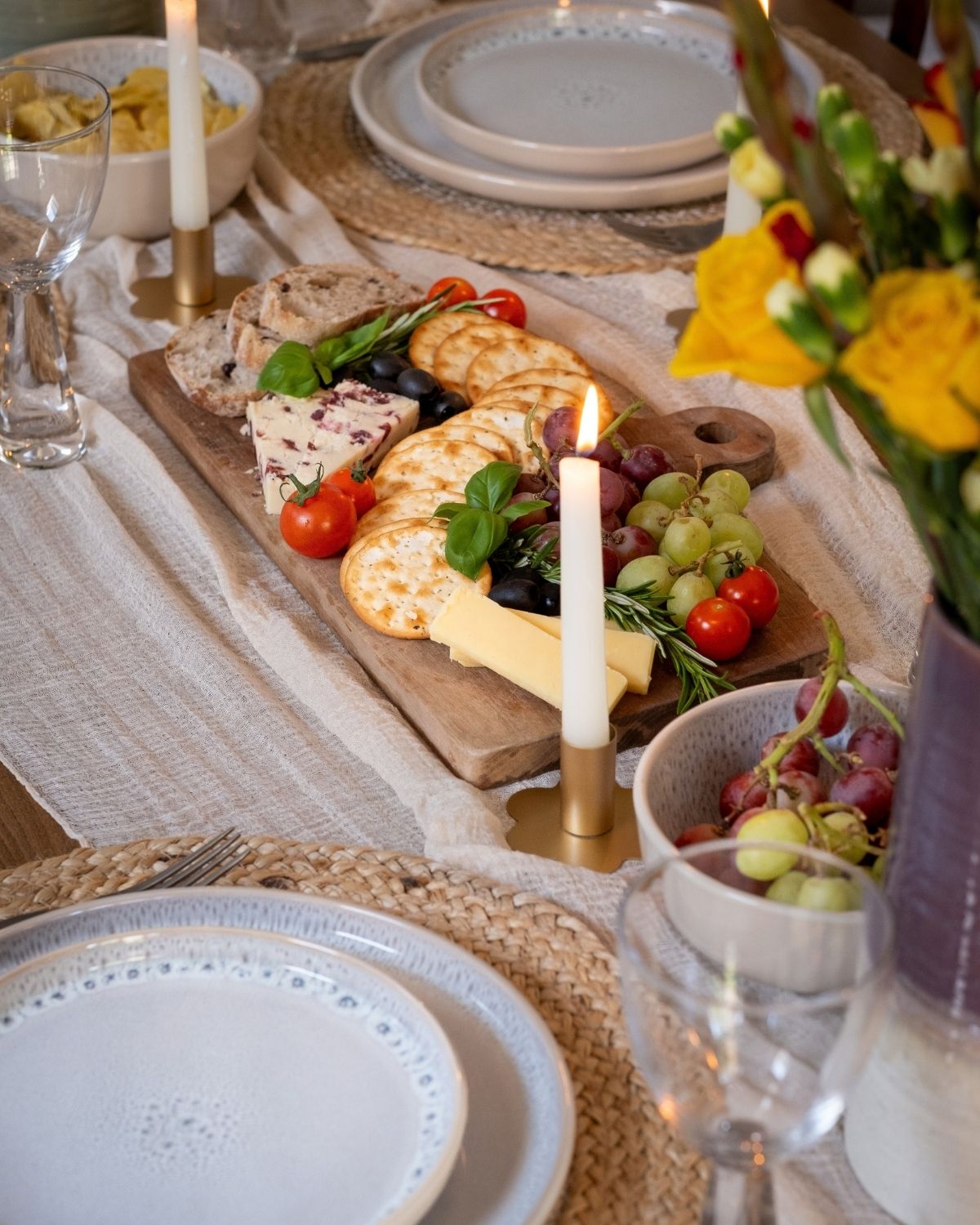
If you only do one thing on this list, do this one. Nothing else moves a table from daytime to evening as quickly as turning the overhead light off.
Two or three candles at different heights, down the centre, at or below eye level so nobody is looking through a flame at the person opposite. A lamp on a nearby surface rather than the ceiling light. If there is a window, a single candle on the sill does more than it should.
Keep candles away from foliage and anything trailing, and do not leave them burning in an empty room. It is the obvious point and it is the one everybody forgets in October.
Texture, and why reactive glaze suits autumn
Summer tables can be smooth and pale and still look good in strong daylight. Autumn light is lower and softer, and it needs something to catch on.
That is where texture earns its place. Linen rather than cotton. A wooden board. Rough ceramic rather than fine china. Reactive glaze is particularly good in this light because the surface is not uniform: the glaze moves as it fires, pooling in some places and lifting in others, so every piece comes out slightly different from the one next to it. Under a candle, that variation is the thing your eye follows.
Three or four textures on one table is plenty. More than that and it starts to look like a display rather than a dinner.
Small tables, round tables and tables that have to be cleared
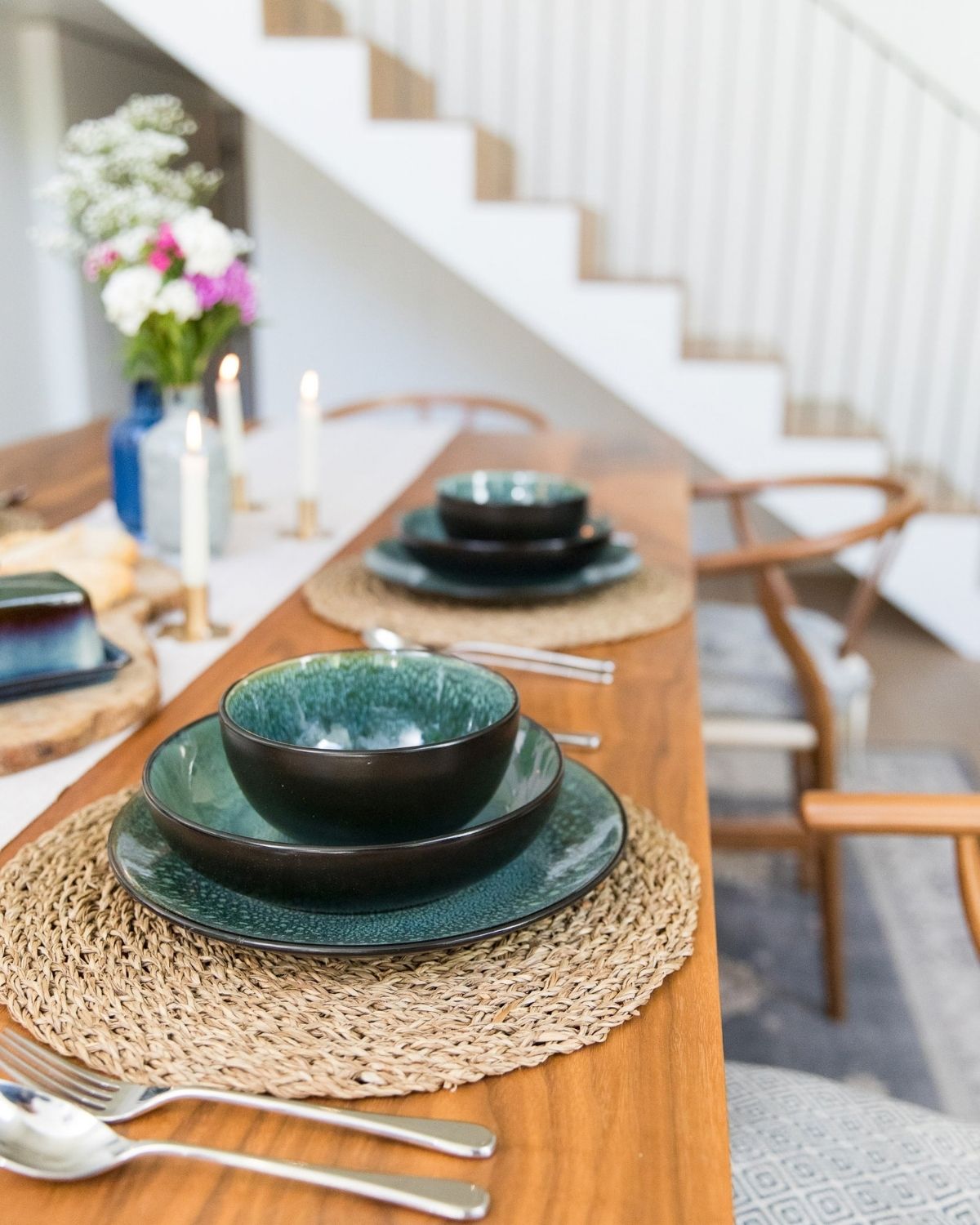
Most styling advice assumes a long rectangular table that nobody has to eat breakfast at the next morning. Real tables are often round, often small, and usually in use.
On a small table, drop the runner and use a single tray or board in the middle instead. It gives you the same anchor without taking the space you need for plates.
On a round table, work from the centre outwards rather than along a line. One central arrangement, low, with settings evenly spaced around it. Anything long looks wrong on a circle.
On a table that has to be cleared, keep the whole arrangement on one tray. Then it lifts off in one movement at eight in the morning and goes back at six in the evening, which is the only version of table styling that survives a normal week.
How to keep it going all season
The reason most autumn tables last a fortnight is that they are built out of things that die. Cut foliage looks wonderful for four days and apologetic for the next ten.
Build the permanent part out of things that do not change, so the ceramics, the board, the candles and the linen, and let the seasonal part be small and easily replaced. A few stems, a handful of conkers, whatever the garden is doing that week. Then refreshing the table takes two minutes rather than a trip out.
When the evenings get properly dark in November, the same table takes almost no work to move towards Christmas. Swap the accent colour, add one more candle, and leave everything else exactly where it is.
Three things that make a table look worse
Worth naming, because each one is easy to do without noticing.
Too many small objects. Three well chosen things read as considered. Nine read as clutter, however nice each one is on its own. If in doubt, take something away rather than adding.
Decoration at eye level. Anything tall in the middle means the people either side of it spend the evening leaning. Keep the centre low, or tall and narrow enough to see past.
Everything matching exactly. A table where every piece is identical looks bought rather than lived with. This is the quiet advantage of reactive glaze: the variation is already there, so the table has some life in it without you having to arrange for it.
What we used on this table
- Havn 12 Piece Ceramic Tableware Set, Blue Reactive Glaze, £80
- Rivah 16 Piece Ceramic Tableware Set, Green Reactive Glaze, £100
- Stockholm tableware in Oatmeal reactive glaze, back in stock in October
- Reactive glaze ceramic mug sets, from £20
- Paris ceramic butter dishes, £20
- Ceramic oil and vinegar bottles, set of two, £20
Free standard UK delivery on every order.
Keep reading
You must be logged in to post a comment.